


Hanoi with Kids: A Family Travel Guide
Updated: Sep 9

The first thing that surprises most parents about Hanoi with kids isn't the traffic. It's how much of daily life happens at knee height for a child: low plastic stools outside food stalls, vendors squatting to sell fruit from a basket, motorbikes parked close enough to touch. Kids notice this before adults do.
Hanoi isn't a city built for families the way a theme park is. There's no single "kids' zone." But that's also what makes it work: children end up doing what locals do, not what tourists do, and that tends to hold their attention longer than a monument.
Is Hanoi with Kids Actually a Good Idea?
Yes, with some adjustment to pace. The Old Quarter is walkable but uneven, with narrow sidewalks, motorbikes parked on them, and the occasional open drain cover. This does not mean families should avoid walking here, but it does mean parents need to stay attentive, hold younger children's hands near traffic and allow more time than the average guidebook itinerary assumes. Budget for the slower pace instead of fighting it.
What age works best
Most families find the sweet spot from about 4 years old, once a child can walk a few kilometers across a day with breaks and isn't napping on a strict schedule. Toddlers can still visit, just expect to carry more and see less.
Food: the easiest part, not the hardest
Parents often brace for a food fight before the trip and end up surprised. Plain rice, grilled meats, fresh spring rolls, and banh mi without the fillings kids might not want are all easy to find. The harder skill isn't finding kid-friendly food, it's ordering it in a way that doesn't feel like a negotiation with a stranger. That's usually where having someone local do the ordering helps more than any packing list.
A different kind of "sightseeing"
The temples and the lake are still worth seeing, but the moments families mention afterward are rarely the landmarks. It's more often something small: a vendor letting a child stir a pot, a shopkeeper teaching them a word in Vietnamese, five minutes spent watching someone fold banh cuon by hand.
Planning a family trip to Hanoi isn't about finding the version of the city that's easiest for a child. It's closer to finding the version that was already easy for one; you just have to know where to look.
Crossing Streets and Walking the Old Quarter
The traffic is usually the part parents worry about before arriving. The practical rule is to be predictable: cross at a steady pace, keep young children close and use pedestrian crossings or quieter corners when they are available. Sidewalks are not always clear, so a ten-minute walk on a map may take longer with children.
Strollers, Naps and Midday Breaks
A lightweight stroller can still be useful for toddlers, but it will not roll smoothly everywhere. Curbs, parked motorbikes and uneven paving mean you will sometimes lift it or move into the edge of the street. For young children, it is often easier to plan one active block in the morning, a proper lunch and rest, then another short block later in the afternoon.
Heat and Rain Change the Plan More Than Distance
In hot months, a route that looks short can feel long very quickly. Start earlier, use cafés and indoor stops as real breaks rather than quick photo stops, and avoid building the day around the hottest hours. In rain, slow down rather than trying to keep the original schedule; Hanoi is much more enjoyable when the plan can bend.
What Usually Keeps Children Interested
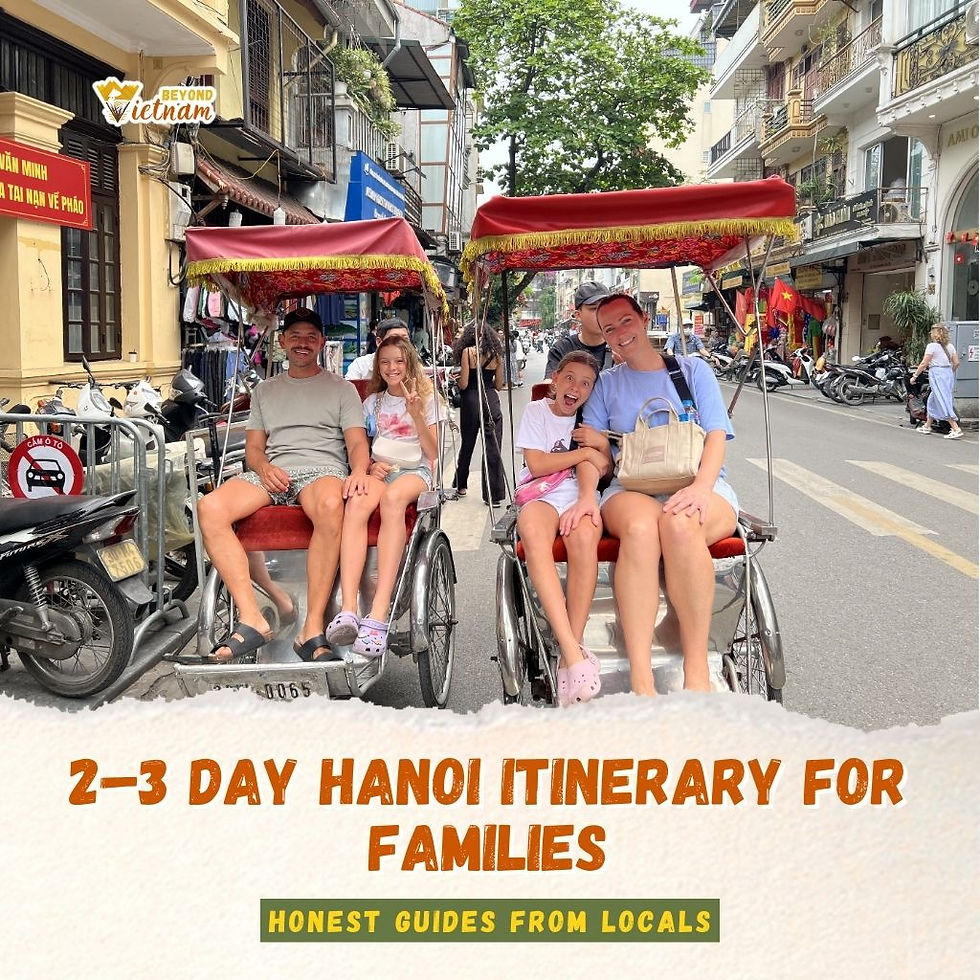
Markets, food preparation, short craft activities, cyclo rides, small snacks and places where children can touch, make or choose something tend to work better than a long chain of monuments. The city becomes easier for kids when they are participants rather than passengers.
How Many Days Do Families Need?
Two to three days is enough for many first-time families to get a feel for Hanoi without turning the visit into a checklist. One lighter arrival day, one main family day and one flexible day gives you room for jet lag, weather and the simple fact that children sometimes want to stop for a drink when adults want to keep moving.
Related reading: What Picky Eaters Actually Eat in Hanoi and A Simple 2-3 Day Hanoi Itinerary for Families.
Dung (Emma) Co-founder of Beyond Vietnam
Xin chào! I’m Dung, but many travellers call me Emma. I grew up on the outskirts of Hanoi, and no matter how far I travel, this busy and slightly chaotic city still feels most like home.
I’ve explored Vietnam on my own and with the people I love, while also spending years volunteering and joining community projects. Along the way, I’ve collected plenty of stories, local tips and unforgettable moments. I share them here to help you feel closer to Hanoi and Vietnam, hopefully even before you arrive.
You can also find me on Facebook. Come and say hi!

Comments