


Wooden Stamp Carving in Hanoi: A Souvenir with a Story
Updated: 1 day ago

⚡ Quick Local Summary • Keep Walking Blocks Short & Interactive: Exploring Hanoi with children or extended family works best when you alternate 15-minute strolls with seated snack stops, shaded courtyards, and hands-on folk crafts. • Mild & Approachable Northern Flavors: Traditional Hanoian cooking relies on clear broths, fresh herbs, and crispy rice-flour textures rather than heavy chili heat, making it easy to adapt for younger palates. • Pace Around the Midday Weather: Save outdoor sightseeing for the morning and late afternoon, and use the 1:30 PM to 4:00 PM window for indoor cultural breaks.
Walk along Hàng Quạt Street and the workshop is easy to miss. It is small, open to the street and crowded with wooden blocks in different shapes and sizes. At the centre sits an artisan, turning a name, an animal or a family idea into a stamp, one careful cut at a time.
There is no production line and no screen doing the difficult work. The design takes shape through the movement of a knife and chisel across the wood.
For families exploring Hanoi, the workshop offers a close-up view of a craft that still survives in the busy Old Quarter. Children can follow the change from a plain block of wood to a personal design, while parents see the time and control behind each cut. The finished stamp carries a clear connection to the person and place that made it.
A Small Workshop That Holds Part of Old Hanoi
Hanoi’s Old Quarter is known for streets that grew around particular trades. Many have changed, but small workshops still appear between cafés, clothing stores and modern businesses. Wooden stamp carving is one of the quieter crafts that remains.
Artisan Phạm Ngọc Toàn has spent decades making hand-carved wooden stamps on Hàng Quạt Street. Around him are rows of finished designs: flowers, animals, Vietnamese motifs, names and small illustrations. Some are ready to use, while others begin with an idea brought in by a customer.
The shop is a working space rather than a formal museum exhibit. Visitors can stand close enough to see the tools, wood shavings and concentration behind each line, meeting one of the people keeping this craft alive.
How a Wooden Stamp Takes Shape
The process begins with a suitable piece of wood. Its surface must be smooth enough to receive the design and firm enough to hold small details.
The artisan then prepares the image in reverse. This is one of the most interesting details for children to notice. Letters and directional images must be carved backwards so that they appear correctly when pressed onto paper.

Using small knives, chisels and rasps, the artisan removes the areas that should remain blank. The raised wood becomes the part that carries the ink. After the first test print, uneven edges are adjusted until the image is clear.
A simple stamp can take shape relatively quickly. A detailed portrait or complicated illustration requires more time and patience. Either way, there is little room for careless movement. Once a piece of wood has been removed, it cannot be put back.

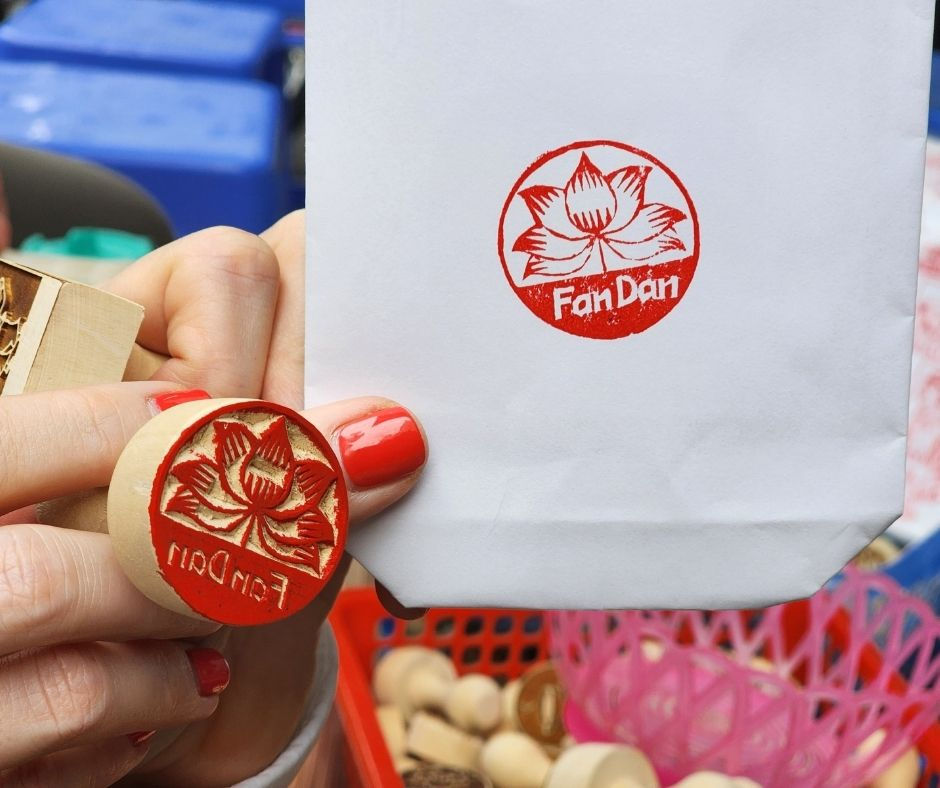


The first test print makes the reversed carving easy to understand: the image appears the right way round, and the artisan can immediately see which edges still need refining.
Why Families Enjoy This Hanoi Craft Experience
Children do not need a long explanation to understand what is happening. They can see the transformation in front of them.
The experience often leads to good questions. Why is the image backwards? What happens if the artisan cuts too deeply? How can such a small tool make a curved line? Will every print look exactly the same?
Adults tend to enjoy the same moment for a different reason. Watching the artisan work offers a slower and more personal view of Hanoi. The value lies not only in the finished stamp, but also in meeting its maker and understanding the work behind it.
Visitors should remember that the carving tools are sharp. This experience focuses on observing the artisan and receiving a personalised stamp rather than asking children to handle professional tools.
The wooden-stamp visit is included in Hanoi Family Quest, a half-day experience created for families who want to discover Hanoi through food, local people and hands-on cultural encounters.
Choosing a Design for Your Stamp
A good stamp design does not need to be complicated. Clear shapes and strong lines often produce the most satisfying result.
Families might choose:
A child’s name
A favourite animal
A flower or simple Vietnamese motif
A small symbol connected to the trip
A design the family chooses together

Children often enjoy being part of the decision, even when the artisan completes the carving. Choosing the image gives them a sense of ownership, while watching it appear in the wood helps them understand why handmade objects take time.
The finished stamp can be used in a travel journal, on cards, in a scrapbook or on children’s drawings. It is useful, personal and small enough to carry home without filling another corner of the suitcase.
Turn One Craft Visit into a Family Adventure
The stamp shop is meaningful on its own, but it also fits naturally into a day of things to do in Hanoi with children, especially when you combine short cultural stops with food and time to move around the Old Quarter.
The wider route connects the artisan visit with a local breakfast, a traditional Hanoi house, a neighbourhood market, a short cyclo ride and bamboo dragonfly painting. That mix gives children regular changes of pace: they can taste, watch, move and create rather than follow one long sightseeing sequence.
The experience lasts four hours and is designed for families with children. An English-speaking local guide helps explain what you are seeing, introduces the people along the route and keeps the day moving at a comfortable pace.
The current tour includes one personalised wooden stamp per couple. Families who would like more than one should check the latest inclusions when booking.
Bring Home More Than a Souvenir
A finished stamp is compact and useful, but the carving process is what gives it meaning: you have watched the design move from an idea to a tool you can keep using at home.
If your family would like to meet the artisan as part of a guided morning, Hanoi Family Quest brings this stop together with food, crafts and everyday stories from the Old Quarter.
Frequently Asked Questions
Where can I see wooden stamp carving in Hanoi?
Wooden-stamp workshops can be found around Hàng Quạt Street in Hanoi’s Old Quarter. Artisan availability may change, so confirm before making a special visit.
Do visitors carve the stamps themselves?
The experience described here focuses on meeting the artisan, watching the carving process and receiving a personalised stamp. Visitors should not expect children to handle the sharp carving tools.
Is the experience suitable for young children?
Yes. The process is visual, easy to follow and does not require children to sit through a long explanation. Adults should supervise them inside the workshop.
Is a wooden stamp included in Hanoi Family Quest?
The current itinerary includes one wooden stamp per couple. Check the tour page when booking for the latest inclusions and itinerary information.
Exploring Hanoi With Your Family & Our Local Team
If you want your family's time in Hanoi to feel relaxed and hands-on, our interactive Hanoi Family Quest turns the Old Quarter into a playful cultural adventure with clues, wooden stamp carving with a local artisan, painted bamboo dragonflies, and kid-friendly snacks. Families also love cooling off at our 2-hour indoor Cocoa-Coffee Workshop ($20 USD per person at 9:00 AM and 2:00 PM, where kids 6+ craft Vietnamese Artisanal Cocoa alongside parents brewing Egg, Salt, and Coconut Coffee), joining our daily Taste of Hanoi street food walk (10:00 AM and 6:00 PM), or booking our private car-based Hanoi Bites & Sights when traveling with grandparents. Feel free to reach out on WhatsApp (+84 969 655 521) anytime for honest family planning advice.
Frequently Asked Questions
1. Is Hanoi's Old Quarter manageable for families with children or older relatives?
Yes, as long as you break your day into short 15-minute walking segments separated by seated cafe or snack stops. On Friday, Saturday, and Sunday evenings, the entire road loop around Hoan Kiem Lake closes to traffic, creating a wide pedestrian promenade where families can stroll comfortably.
2. Are Northern Vietnamese dishes too spicy for children or cautious eaters?
No. Unlike Thai or Sichuan cuisine, traditional Hanoian cooking is naturally mild, with fresh chilies and garlic vinegar kept in separate jars on the table. Dishes like chicken noodle soup (Phở Gà), steamed rice rolls (Bánh Cuốn), crispy spring rolls (Nem Rán), and honey-glazed rice donuts (Bánh Rán) are very popular with kids.
3. What is the best time of day for outdoor sightseeing in Hanoi?
Starting between 8:00 AM and 10:30 AM lets you enjoy cooler temperatures and calmer courtyards at landmarks like the Temple of Literature, leaving the warmest midday hours (1:30 PM to 4:00 PM) for indoor museums, craft workshops, or a hotel rest before dinner.
Keep Exploring Hanoi with Us

Dung (Emma) · Co-founder of Beyond Vietnam Xin chào! I grew up on the outskirts of Hanoi, and no matter how far I travel, this busy and slightly chaotic city still feels most like home. I’ve explored Vietnam on my own and with the people I love, while also spending years volunteering and joining community projects. Along the way, I’ve collected plenty of stories, local tips and unforgettable moments. I share them here to help you feel closer to Hanoi and Vietnam, hopefully even before you arrive. You can also find me on Facebook. Come and say hi!


Comments