


Xoi in Hanoi: Sticky Rice for Breakfast
Updated: Oct 25
⚡ Quick Local Summary • Single-Dish Family Specialists: Hanoi's most memorable street food comes from small family-run kitchens that perfect just one or two dishes and serve them during specific morning, lunch, or evening shifts. • Fresh Heat & Balanced Seasoning: Northern Vietnamese dishes emphasize fragrant bone broths, charcoal smoke, fresh green herbs, and tabletop condiments like garlic vinegar (Giấm Tỏi Ớt) and kumquat (Quất) so every diner can season their own bowl.
Before Hanoi fully wakes up, xoi is already everywhere: tucked into baskets, scooped from steaming pots, wrapped for commuters and carried away on motorbikes.
It does not have pho’s international fame, but xoi may tell you more about an ordinary Hanoi morning because it fits real life so well, warm, filling, inexpensive and easy to take away.
What Is Xoi in Hanoi?
Xoi is glutinous rice steamed until the grains cling together while still keeping some chew. It can be sweet or savoury, plain or loaded with toppings, and there are dozens of regional and family variations across Vietnam.
The Hanoi Version Many Locals Grow Up With: Xoi Xeo
Xoi xeo is one of northern Vietnam’s most recognisable versions. Yellow sticky rice is topped with thinly shaved mung bean, fried shallots and often a little chicken fat or oil. The result is richer than it looks: soft rice, powdery mung bean and crisp shallots in the same bite.
Other Savoury Orders to Know
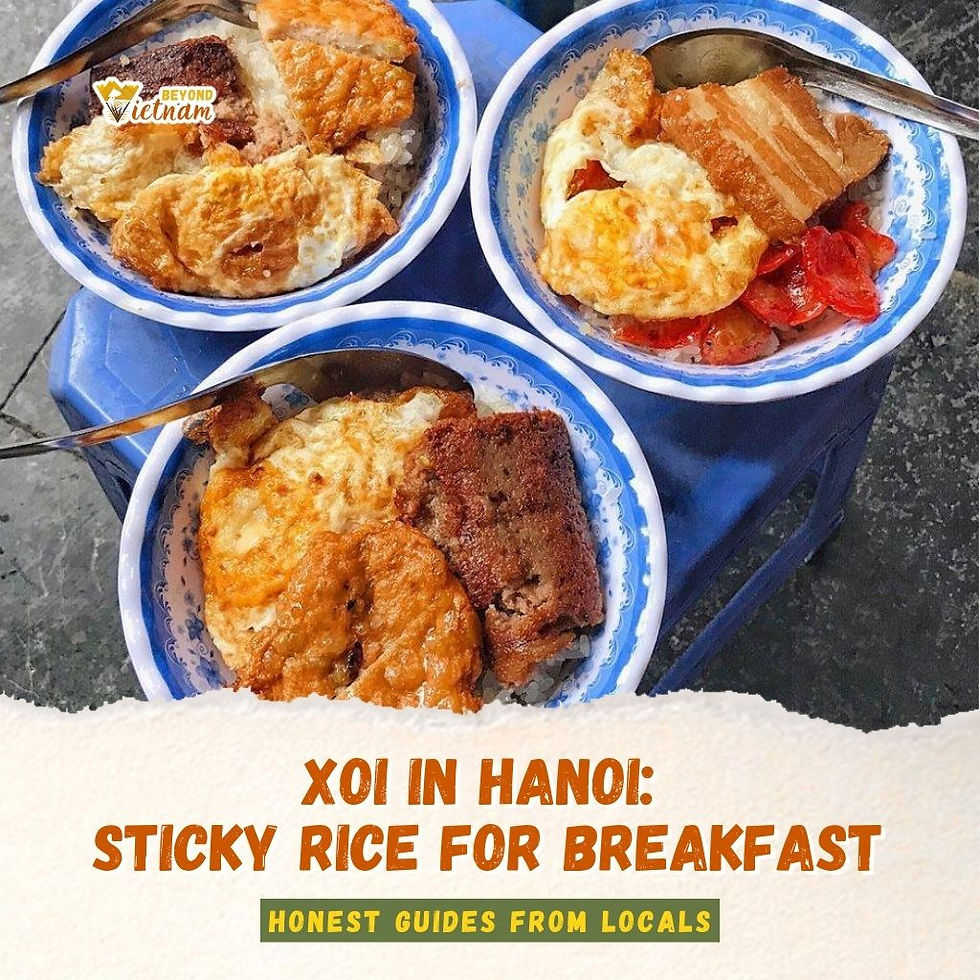
Xoi ga adds shredded or chopped chicken. Xoi cha pairs sticky rice with Vietnamese pork sausage. Some shops add braised pork, pate, eggs or floss, turning what started as a simple breakfast into a very substantial meal.
Sweet Xoi Is a Different World
Sweet versions may include mung bean, black beans, peanuts, coconut, gac fruit or sesame. They can appear at breakfast, family gatherings, temple offerings and celebrations, so xoi is not only an everyday commuter food; it also has a ceremonial side.
Why It Fits the Morning So Well
Sticky rice holds heat, travels well and keeps people full. That makes it ideal for school runs, office mornings and market workers who need something more substantial than a pastry but do not have time to sit over a bowl of noodles.
How to Order
Xoi xeo for the classic northern mung-bean version.
Xoi ga if you want something familiar and filling.
Ask what toppings are available rather than assuming every stall has the same menu.
If you see a busy basket vendor early in the morning, buy then; small vendors often finish when their batch is gone.
Why Travelers Miss It
Xoi is not visually dramatic. It rarely arrives in a beautiful bowl and often gets handed over in paper or a takeaway box. That is exactly why it is worth noticing. It is food built for people who are going somewhere, not food built to be photographed.
Pair this with our guide to Where to Eat in Hanoi Old Quarter, or discover more everyday dishes on Taste of Hanoi.
Walking & Eating Through Hanoi With Us
If you would like to explore these neighborhood kitchens with a local friend who knows the families behind the stoves, join us on our daily Taste of Hanoi street food walk (running at 10:00 AM and 6:00 PM for 3 to 3.5 hours across 6 to 8 family-run stops, serving 6 to 7 full dishes plus a local cafe drink, with dedicated Veggie Delight and Off the Beaten Path routes available right on the booking form). Depending on your travel style, you can also combine history and food on Hanoi Eat & Explore or private car-based Hanoi Bites & Sights, bring the kids on our Hanoi Family Quest, or spend two cool hours at our $20 USD Cocoa-Coffee Workshop (9:00 AM and 2:00 PM). Message us anytime on WhatsApp (+84 969 655 521) if you want local tips for your trip.
Frequently Asked Questions
1. How do Hanoians spot a great street food stall in the Old Quarter?
Locals look for single-dish stalls that are busy during local meal rushes (breakfast from 6:30 AM to 9:30 AM, lunch from 11:30 AM to 1:30 PM, and dinner from 6:00 PM to 8:30 PM) where broths are kept at a rolling boil and dishes are cooked fresh to order.
2. Do Hanoi street food stalls accept credit cards, or should we carry cash?
Family-run sidewalk stalls and wet-market vendors operate almost exclusively with Vietnamese Dong (VND) cash for visitors. Carrying smaller banknotes (20,000, 50,000, and 100,000 VND notes) makes paying for bowls of noodles and drinks quick and easy.
3. How can vegetarians or travelers with food allergies order safely on the street?
Because clear broths often use pork or chicken bones and dipping sauces use anchovy fish sauce (Nước Mắm), simply saying 'no meat' is often misunderstood. Carrying a short written Vietnamese note on your phone explaining your exact dietary needs or visiting dedicated plant-based (Chay) kitchens is the safest approach.
Keep Exploring Hanoi with Us

Dung (Emma) · Co-founder of Beyond Vietnam Xin chào! I grew up on the outskirts of Hanoi, and no matter how far I travel, this busy and slightly chaotic city still feels most like home. I’ve explored Vietnam on my own and with the people I love, while also spending years volunteering and joining community projects. Along the way, I’ve collected plenty of stories, local tips and unforgettable moments. I share them here to help you feel closer to Hanoi and Vietnam, hopefully even before you arrive. You can also find me on Facebook. Come and say hi!


Comments