


Should You Book a Hanoi Food Tour, or Explore the Alleys Alone?
Updated: Sep 9

“I would never try these dishes if I was exploring on my own.”
That's something we hear often enough that it stopped surprising us a while ago.
The first time most people see Hanoi street food, it can feel a little intimidating. Many of the good spots are tucked into narrow alleys, small corners you would probably walk past without a second look. There's no menu on the wall in English, no sign telling you where to sit, no obvious way to know if the stool you're about to take is even meant for customers.
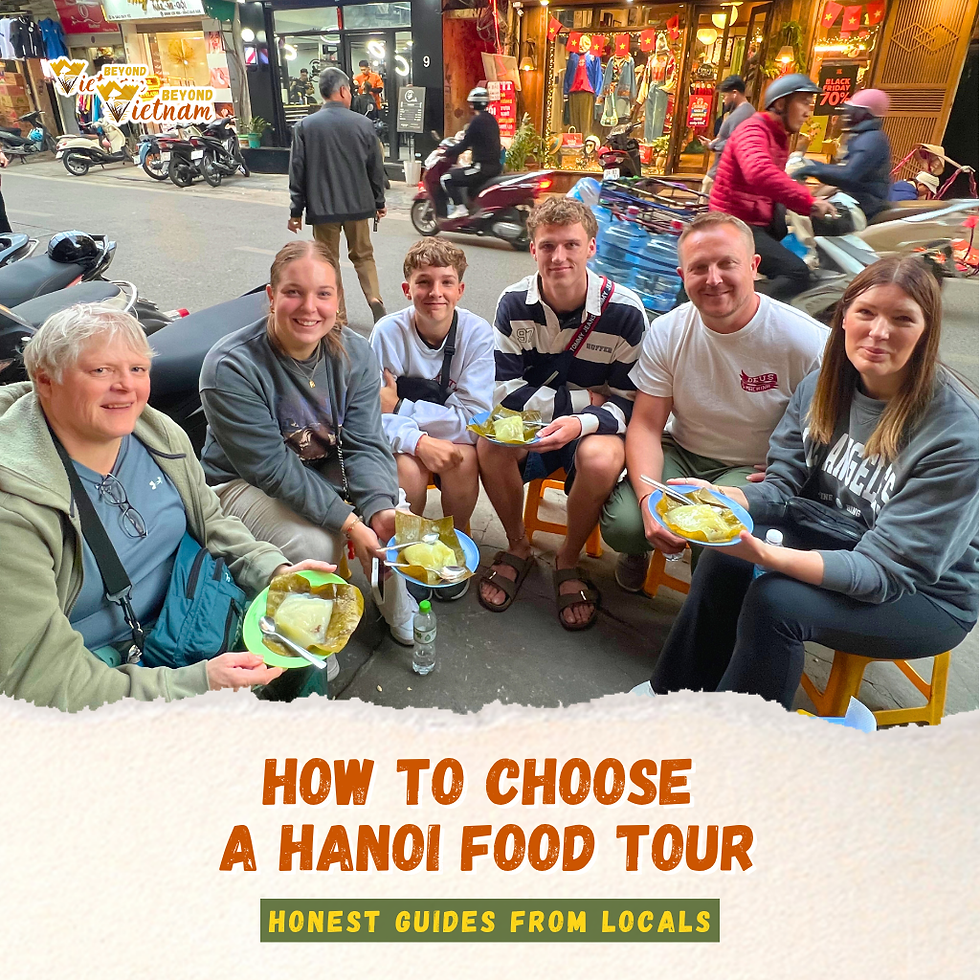
Then you find yourself sitting inside a narrow Old Quarter house, almost hidden from the street. A tiny table, low plastic stools, knees nearly touching your neighbour's. Bright chopsticks in hand. Around you, locals chatting, laughing loudly at something you didn't quite catch. A motorbike passes close enough that you feel the air move. Somewhere behind you, the “leng keng” of a cyclo bell.
And then the first bite – maybe a soft piece of bánh cuốn, or a spoon of bún riêu. A short pause. A surprised look. And then: “wait... this is actually really good?”
That reaction is the reason this article exists. Because the question we hear most, before anyone books anything, isn't “what should I eat in Hanoi.” It's this one: should we do a Hanoi food tour, or can we just find these places ourselves?
Honest answer: you can find some of it yourself. Here's what that actually looks like, and where a guide changes the experience.
Should You Book a Hanoi Food Tour, or Explore the Alleys Alone?
It's rarely the food itself. It's not knowing where to sit, how to order without a menu, what a fair price looks like, or whether you're welcome at a stall with no sign and no English. Those small uncertainties are usually enough to keep visitors on the main streets, eating somewhere built for tourists instead.
On a first trip, the Old Quarter can feel like it's arranged for people who already know where they're going. Stalls don't advertise. Prices aren't posted. The dishes worth trying are often the ones without a photo menu at all. None of that is a problem once you know the pattern – it just takes a bit of time, or a local, to learn it.
What does a guide actually change?
A guide removes the guesswork, not the food. They know which stall does one dish well, roughly what it should cost, and how to order it the way a regular would – not a version simplified for visitors. What's left for you to do is sit down, eat, and be curious.
This is the part that surprises people most: a guide doesn't replace the experience of discovering a place, they just get you through the door. You still sit on the same tiny stools, eat off the same chipped plates, and get the same reaction from the vendor when you ask for extra chilli. The only difference is you're not standing outside for ten minutes trying to decide if it's okay to go in.
Can you find the same food on your own?
Yes, some of it. A handful of well-known dishes are easy enough to find with a bit of research and a translation app. What's harder to find alone is the food that isn't written up anywhere – the stall that's only known because one neighbour told another, years ago.
If your trip is mostly about phở, bún chả, or bánh mì, you'll manage fine without a guide. Most guesthouses can point you in the right direction, and the popular spots are used to visitors. Where it gets harder is everything without a sign, a review, or an English word in sight – and in the Old Quarter, that's a lot of the good stuff.
Is a Hanoi Food Tour Worth It If You're Travelling with Kids?
For families, a guide often matters more, not less. Kids ask questions adults wouldn't think to, want to know what something is before they try it, and do better with a slower pace and someone to explain what's happening around them.
Travelling with children changes the calculation a bit. It's not just about finding good food, it's about managing a new environment – traffic, crowds, unfamiliar smells – while also making sure everyone actually eats something. A guide who's used to walking with families can read a child's hesitation and adjust without anyone having to say so.
A quick comparison
Exploring on your own
Costs less, on your own schedule
Works well if you're mainly after dishes you already know
Takes some trial and error to find the good spots
Ordering and pricing can slow you down without the language
Easy to walk straight past the places with no sign
With a guide
Costs more than a bowl of noodles bought solo
Runs on a fixed time slot
Opens up places you likely wouldn't find, or wouldn't feel comfortable entering, alone
Ordering, pricing, and etiquette handled for you
Room for the small moments – a vendor asking about your kids, someone teaching you a word – that are harder to reach on your own
Neither way is wrong. Some travellers genuinely enjoy the trial and error of finding a stall on their own, and that hunt is part of the trip for them. Others would rather spend their one afternoon in the Old Quarter actually eating, not circling the block looking for a place that might not exist by the time they find it.
If it's the second one that sounds like you, come explore it with us on Taste of Hanoi – we'd love to show you the alleys we grew up walking past.
Frequently Asked Questions
Is a Hanoi food tour worth it for a short trip?
If you only have a day or two in Hanoi, a tour usually saves more time than it costs. You get oriented to the food and the streets in a few hours instead of a few days of trial and error.
Can picky eaters or young kids join a Hanoi food tour?
Yes. On a small-group tour, the pace and the dishes can flex around who's in the group, which is harder to manage when you're ordering solo somewhere without an English menu.
How much does street food cost if I explore Hanoi on my own?
Street-level prices in Hanoi run roughly: a bowl of phở or bún is 30,000–50,000 VND (about US$1.20–2), a bánh mì is 15,000–25,000 VND (about US$0.60–1), a regular Vietnamese coffee is 20,000–30,000 VND, and egg coffee at an established shop is closer to 25,000–40,000 VND. Prices tend to run a little higher in the busiest corners of the Old Quarter, and a little lower a few streets away.
Related reading: How to choose a Hanoi food tour and Is a Hanoi food tour worth it?.
Dung (Emma) Co-founder of Beyond Vietnam
Xin chào! I’m Dung, but many travellers call me Emma. I grew up on the outskirts of Hanoi, and no matter how far I travel, this busy and slightly chaotic city still feels most like home.
I’ve explored Vietnam on my own and with the people I love, while also spending years volunteering and joining community projects. Along the way, I’ve collected plenty of stories, local tips and unforgettable moments. I share them here to help you feel closer to Hanoi and Vietnam, hopefully even before you arrive.
You can also find me on Facebook. Come and say hi!


Comments