


How Do You Order Street Food in Hanoi Without Speaking Vietnamese?
Updated: Oct 25

⚡ Quick Local Summary • Single-Dish Family Specialists: Hanoi's most memorable street food comes from small family-run kitchens that perfect just one or two dishes and serve them during specific morning, lunch, or evening shifts. • Fresh Heat & Balanced Seasoning: Northern Vietnamese dishes emphasize fragrant bone broths, charcoal smoke, fresh green herbs, and tabletop condiments like garlic vinegar (Giấm Tỏi Ớt) and kumquat (Quất) so every diner can season their own bowl.
Ordering street food in Hanoi looks harder than it is. Many stalls specialise in one dish, so you are often not choosing from a twenty-item menu at all. You are choosing the number of bowls, the version, perhaps one or two toppings, and whether you are eating there or taking it away.
If you can see the food, point and hold up one or two fingers. This works especially well at bánh cuốn, xôi, grilled-skewer and snack stalls. If another table has what you want, pointing politely toward the dish is normal. You do not need to perform a full Vietnamese sentence before you are allowed to eat local food.
A Few Vietnamese Phrases That Actually Help
“Cho tôi một…” means “Give me one…” and is understandable for ordering. “Không cay” means “not spicy”. “Không hành” is useful if you do not want spring onion or onion garnish. “Bao nhiêu tiền?” asks how much it costs. And “Cảm ơn” means thank you. Pronunciation may not be perfect; a smile, the number on your fingers and the food in front of you usually fill the gaps.
Confirm the Price When It Is Not Clear
At a single-dish stall with a price board, this is usually straightforward. At carts or places in very tourist-heavy streets where no price is displayed, ask before eating. You can type the number into your phone calculator and show it to the vendor. This avoids misunderstandings with large VND numbers and is much easier than trying to hear every zero correctly in a noisy street.
Allergies Need More Than Pointing
For a preference such as “no chilli”, gestures and a short phrase are usually enough. For a real allergy, use a written translation that clearly says what ingredient must be avoided and that cross-contact matters if it does. Vietnamese food can contain ingredients that are not visually obvious: fish sauce in a dressing, shrimp paste in a dip, peanuts as garnish, or seafood-based seasoning in a broth. With a severe allergy, choose places where staff can understand the restriction clearly rather than relying on guesswork.
Do Not Over-Customize a Specialist Stall
A tiny shop serving one noodle soup is not operating like a build-your-own restaurant. Removing chilli or a garnish may be easy; changing the broth, sauce or core filling may be impossible because it was prepared hours earlier. If a request changes the identity of the dish, it is often better to choose another dish that naturally fits your needs.
Cash Is Still Useful
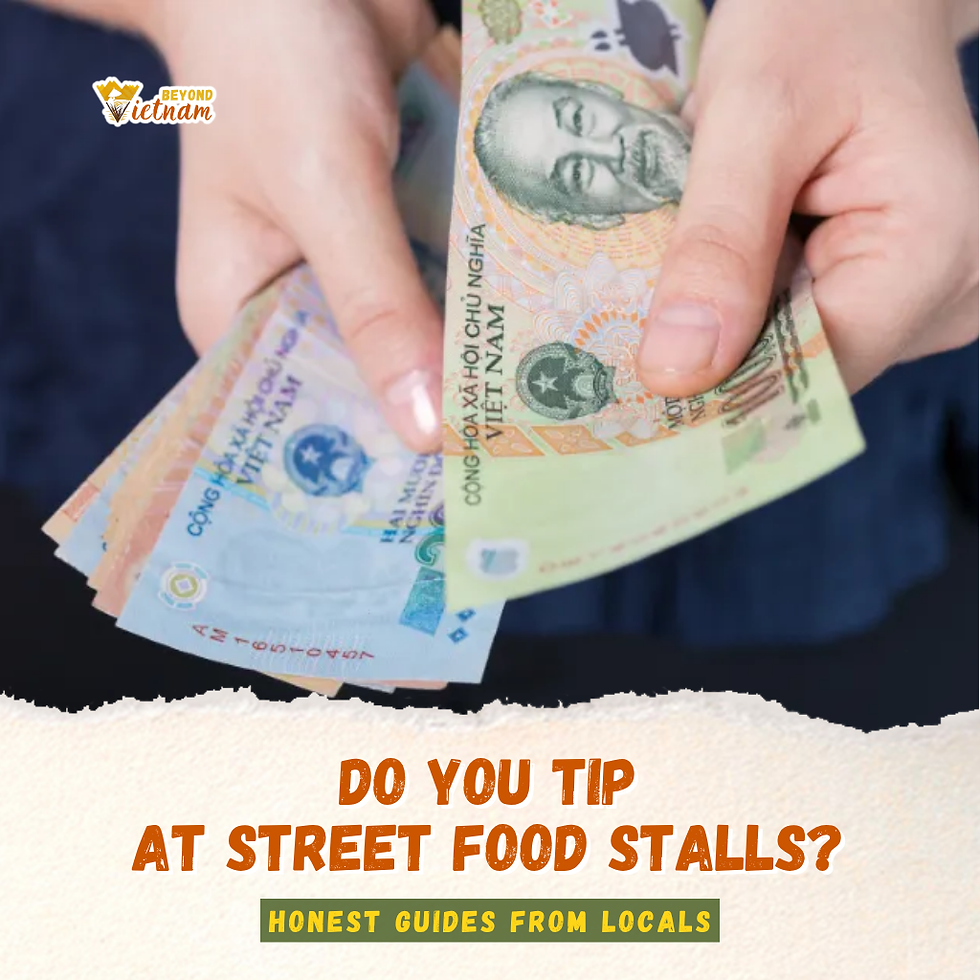
Digital payment is common in Vietnam, but visitors may not have access to local QR systems. Carry smaller VND notes for simple street-food purchases. If you pay with a large note, show it clearly and wait for the change before walking away. For very small vendors, paying with an appropriately sized note makes the interaction easier for everyone.
What a Translation App Cannot Tell You
An app can translate “one bowl, no chilli”. It cannot easily tell you which version regulars order, whether a vendor is almost sold out, why everyone adds a certain condiment, or that a dish is normally eaten only at a particular hour. That cultural layer is the difference between successfully buying food and actually understanding the meal.
The first order may feel awkward. By the third or fourth, you will probably realise Hanoi street food was never asking you to be fluent, only observant, polite and willing to try.
Walking & Eating Through Hanoi With Us
If you would like to explore these neighborhood kitchens with a local friend who knows the families behind the stoves, join us on our daily Taste of Hanoi street food walk (running at 10:00 AM and 6:00 PM for 3 to 3.5 hours across 6 to 8 family-run stops, serving 6 to 7 full dishes plus a local cafe drink, with dedicated Veggie Delight and Off the Beaten Path routes available right on the booking form). Depending on your travel style, you can also combine history and food on Hanoi Eat & Explore or private car-based Hanoi Bites & Sights, bring the kids on our Hanoi Family Quest, or spend two cool hours at our $20 USD Cocoa-Coffee Workshop (9:00 AM and 2:00 PM). Message us anytime on WhatsApp (+84 969 655 521) if you want local tips for your trip.
Frequently Asked Questions
1. How do Hanoians spot a great street food stall in the Old Quarter?
Locals look for single-dish stalls that are busy during local meal rushes (breakfast from 6:30 AM to 9:30 AM, lunch from 11:30 AM to 1:30 PM, and dinner from 6:00 PM to 8:30 PM) where broths are kept at a rolling boil and dishes are cooked fresh to order.
2. Do Hanoi street food stalls accept credit cards, or should we carry cash?
Family-run sidewalk stalls and wet-market vendors operate almost exclusively with Vietnamese Dong (VND) cash for visitors. Carrying smaller banknotes (20,000, 50,000, and 100,000 VND notes) makes paying for bowls of noodles and drinks quick and easy.
3. How can vegetarians or travelers with food allergies order safely on the street?
Because clear broths often use pork or chicken bones and dipping sauces use anchovy fish sauce (Nước Mắm), simply saying 'no meat' is often misunderstood. Carrying a short written Vietnamese note on your phone explaining your exact dietary needs or visiting dedicated plant-based (Chay) kitchens is the safest approach.
Keep Exploring Hanoi with Us

Dung (Emma) · Co-founder of Beyond Vietnam Xin chào! I grew up on the outskirts of Hanoi, and no matter how far I travel, this busy and slightly chaotic city still feels most like home. I’ve explored Vietnam on my own and with the people I love, while also spending years volunteering and joining community projects. Along the way, I’ve collected plenty of stories, local tips and unforgettable moments. I share them here to help you feel closer to Hanoi and Vietnam, hopefully even before you arrive. You can also find me on Facebook. Come and say hi!


Comments